A decade ago, having a proper office with a reception desk and a coffee machine felt like the mark of a “real” business.
Today, a startup running a seven-figure operation out of a coworking space isn’t unusual. It’s actually pretty common.
As more people are freelancing, more companies are building remote or hybrid teams.
And more businesses, be it big or small, are asking the same question: do we actually need a traditional office, or is there a smarter way to work?
That’s exactly what this blog breaks down.
We’re putting coworking vs traditional office space side by side, looking at the real differences, and helping you figure out which one makes sense for where your business is right now.
Because choosing the right workspace today isn’t just about cost, it’s about flexibility, growth, and productivity.
What Exactly Is a Coworking Space?
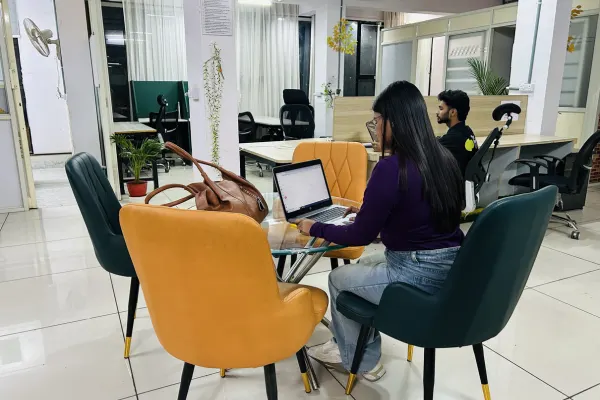
A coworking space is a shared work environment where people from different companies, or from no company at all, come together to work under one roof.
You pay for a membership or a plan, and in return, you get a desk, fast internet, meeting rooms, a kitchen, and sometimes a pretty solid community of fellow professionals.
The beauty of it? You’re not locked in.
Most coworking spaces offer daily, weekly, or monthly plans. You can take a hot desk today and upgrade to a private cabin next month if your team grows.
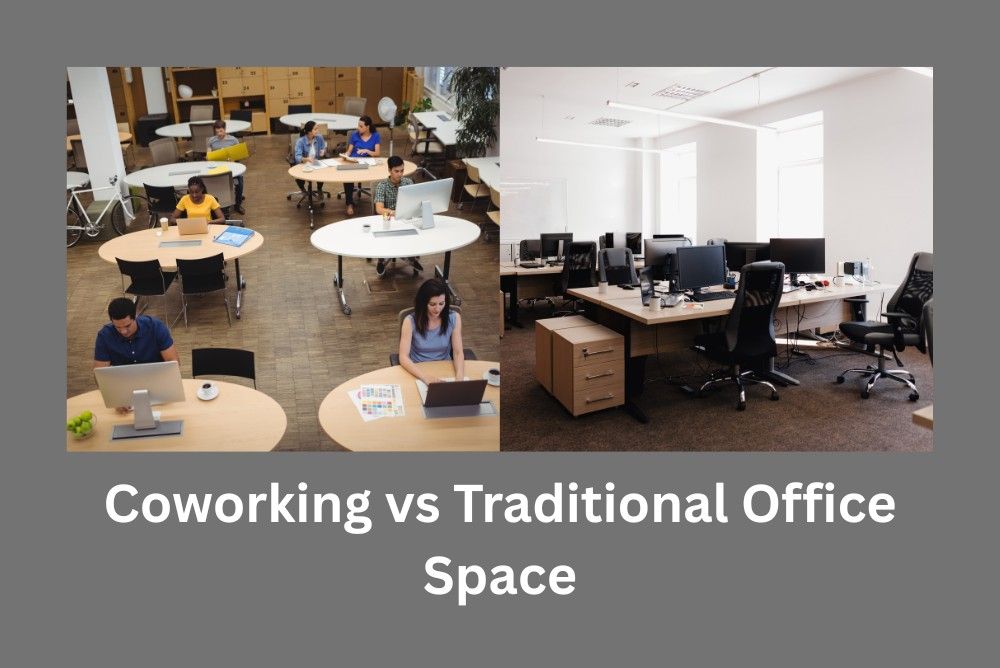
Modern coworking spaces are designed for agility and collaboration. They’re built around the idea that great work doesn’t have to happen in a rigid, nine-to-five cubicle setup.
Read More: What Is a Coworking Space?

Key features of coworking spaces:
a. Flexible plans (daily, weekly, monthly)
b. Fully furnished offices
c. High-speed internet and utilities included
d. Access to meeting rooms and common areas
e. Networking opportunities
Coworking spaces are popular among freelancers, startups, and growing teams for their simplicity and cost-effectiveness.
What Is a Traditional Office Space?
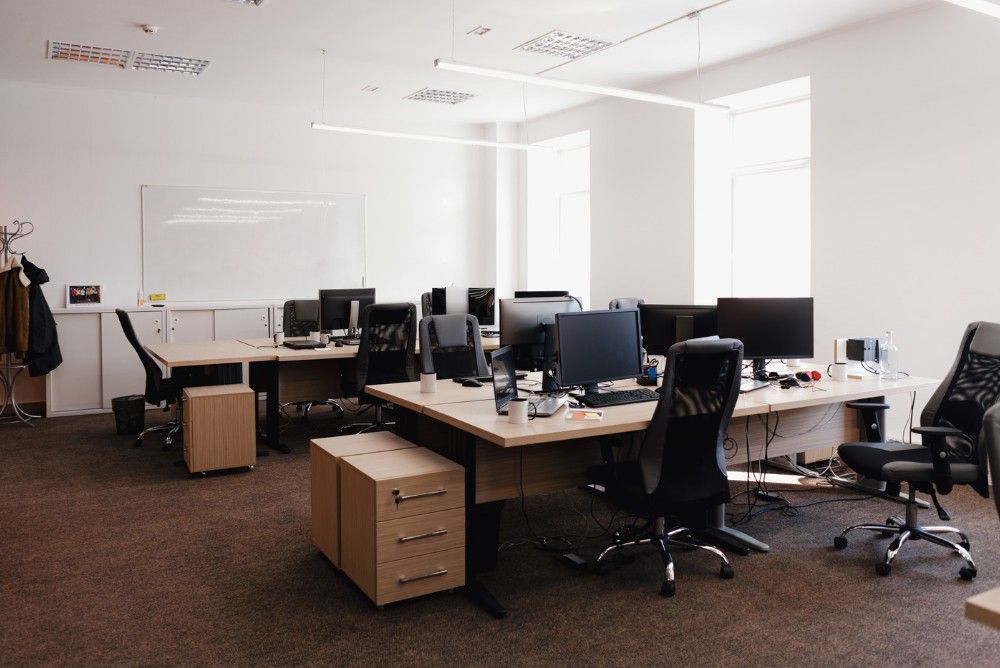
A traditional office space is a workspace that a business leases, usually for a year or more, exclusively for its own use. You sign a contract, pay a deposit, and the space is yours to set up however you like.
That means you’re in charge of the furniture, the internet connection, the cleaning crew, the printer supplies, and everything else that keeps an office running.
It’s a bigger commitment, but it also gives you full control.
Traditional offices tend to suit companies that have a stable team, clear long-term plans, and a need for dedicated, private space.
Key features of traditional offices:
a. Long-term contracts
b. Full control over design and branding
c. Higher upfront costs
d. Responsibility for maintenance and utilities
Traditional offices are often used by large companies with stable teams and long-term plans.
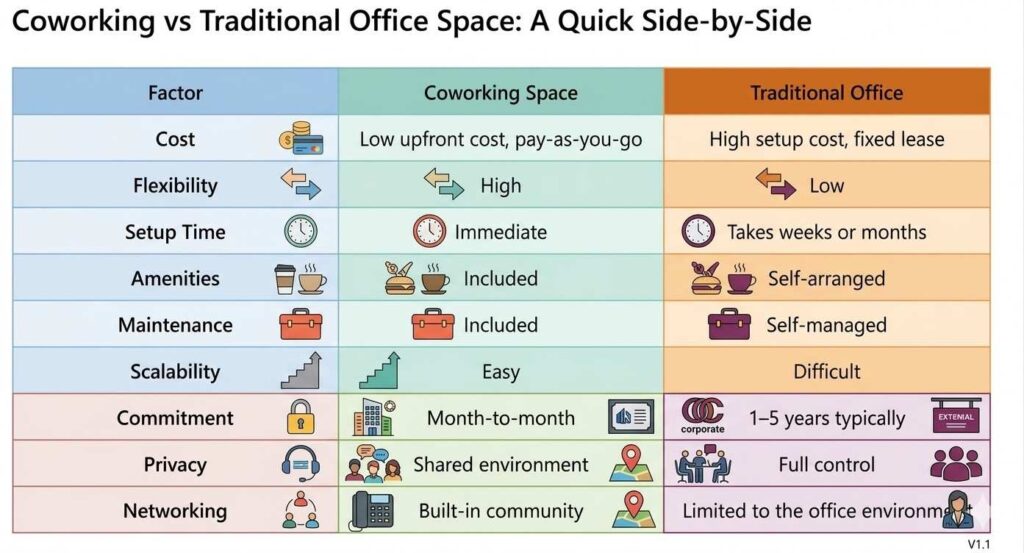
Coworking vs Traditional Office Space: A Quick Side-by-Side
| Factor | Coworking Space | Traditional Office |
| Cost | Low upfront cost, pay-as-you-go | High setup cost, fixed lease |
| Flexibility | High | Low |
| Setup Time | Immediate | Takes weeks or months |
| Amenities | Included | Self-arranged |
| Maintenance | Included | Self-managed |
| Scalability | Easy | Difficult |
| Commitment | Month-to-month | 1–5 years typically |
| Privacy | Shared environment | Full control |
| Networking | Built-in community | Limited to the office environment |
Which option is more cost-effective?
When comparing coworking vs traditional office space, cost is one of the biggest factors.
a. Coworking costs:
a. Pay only for what you use
b. No setup cost.
c. Utilities included
d. No long-term risk
b. Traditional office costs:
a. Rent deposits
b. Furniture and setup expenses
c. Monthly utility bills
d. Maintenance costs
For small businesses and startups, coworking spaces are usually more affordable. They remove the burden of large upfront investments.
If your goal is to save money and reduce risk, coworking is often the better option.
Which option offers more flexibility?
Flexibility is where coworking clearly stands out when compared to traditional office spaces
a. In a coworking space, you can:
a. Increase or reduce seats anytime
b. Upgrade plans easily
c. Move in or out without stress
b. In a traditional office:
a. You are locked into long leases
b. Expanding requires more space and cost
c. Downsizing is difficult
This is why many growing businesses prefer coworking. It allows them to adapt quickly without worrying about long-term commitments.
How does setup and maintenance differ?
Another key point in coworking vs traditional office space is how easy it is to get started.
a. Coworking:
a. Ready-to-use office
b. No setup time
c. Maintenance handled by the provider
b. Traditional office:
a. Requires setup (furniture, internet, etc.)
b. Takes time to become functional
c. You manage everything
If you want to start working immediately without delays, coworking is the easier choice.
Which workspace improves productivity?
Productivity depends on the work environment.
a. Coworking spaces:
a. Energetic and collaborative atmosphere
b. Opportunities to meet new people
c. Designed for focus and comfort
b. Traditional offices:
a. More privacy
b. Better for structured teams
c. Fewer distractions (in some cases)
Many people find coworking spaces more motivating because of the active environment. However, companies that need complete privacy may prefer traditional offices.
What are the pros and cons of each option?
A. Co-Working Space
| Pros | Cons |
| Lower upfront cost | Less privacy |
| No long-term commitment | Can get noisy or crowded |
| Ready to use immediately | Limited customization |
| Networking opportunities | Storage space is limited |
| Scalable plans | Meeting rooms may need booking in advance |
| Prime locations accessible | Ongoing costs can add up for large teams |
B. Traditional Office
| Pros | Cons |
| Full privacy and control | High upfront investment |
| Custom branding and setup | Long-term lease commitment |
| Stable environment for large teams | Setup takes time |
| Better for sensitive operations | Utility and maintenance costs |
| Builds company identity | Less flexibility to scale |
| No shared space concerns | Risk if business circumstances change |
Who should choose coworking spaces?
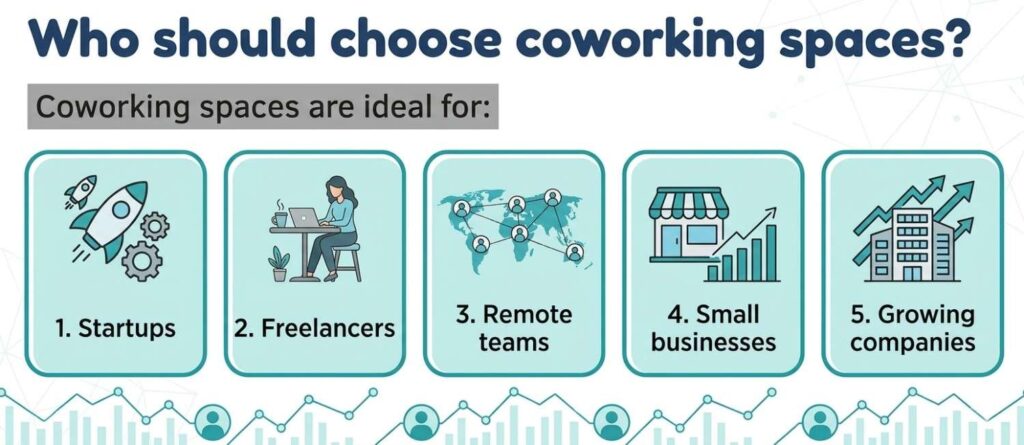
Coworking spaces are ideal for:
a. Startups
b. Freelancers
c. Remote teams
d. Small businesses
e. Growing companies
If your business is still evolving, coworking gives you the freedom to scale without stress.
Many modern businesses choose coworking because it allows them to focus on growth instead of managing office operations.
Who should choose traditional office spaces?
Traditional offices are better suited for:
a. Large companies
b. Businesses needing full privacy
c. Teams with long-term stability
d. Companies with specific branding needs
If your business requires complete control and has stable operations, a traditional office may work well.
Why are modern businesses shifting to coworking spaces?
Over the past few years, there has been a clear shift toward coworking.
Here’s why:
a. Lower operational costs
b. No long-term risk
c. Faster setup
d. Better networking opportunities
e. Access to premium locations
In the debate of coworking vs traditional office space, coworking is becoming a smarter choice for many businesses.
It is not just an alternative anymore; it is a strategic decision.
Which is better: coworking or traditional office space?
There is no one-size-fits-all answer.
The right choice depends on your business needs.
a. Choose coworking if you want flexibility, lower costs, and convenience
b. Choose a traditional office if you need full control and long-term stability
However, for most startups and growing businesses, coworking spaces offer a better balance of cost, flexibility, and productivity.
So, Which One Should You Actually Choose?
Here’s the honest answer: it depends on where your business is right now.
If you’re early-stage, growing, remote-friendly, or watching your budget closely, coworking gives you speed, savings, and flexibility that a traditional office can’t match at that stage.
If you’re a more established business with a large, stable team, specific privacy requirements, or a strong need to build a branded physical space, a traditional lease might be worth the investment.
The good news is that the line between the two has blurred. Many coworking providers now offer private offices and dedicated floors for larger teams, giving you the best of both worlds.
If you’re looking for a flexible, cost-efficient, and ready-to-use workspace, coworking spaces are absolutely worth exploring before locking into a long-term lease.
FAQs
a. Is coworking cheaper than a traditional office?
In most cases, yes, especially for small teams and early-stage businesses. Coworking eliminates setup costs, deposits, and utility bills. However, for very large teams, a long-term lease can sometimes work out cheaper per seat over time.
b. Are coworking spaces good for productivity?
They can be, yes. Many professionals find the energy and structure of a coworking space more motivating than working from home. That said, if your work requires deep focus and minimal distraction, a private office within a coworking space or a traditional office might suit you better.
c. Can small businesses use coworking spaces?
Absolutely. Coworking spaces are often the ideal solution for small businesses. You get a professional environment, meeting rooms, and a business address without the overhead of a full lease.
d. What are the disadvantages of coworking?
The main drawbacks are reduced privacy, limited storage, potential noise, and the fact that you share the space with people you don't work with. For businesses handling sensitive information or requiring strict confidentiality, this can be a genuine concern.