

Quick Summary
The short answer is yes: coworking spaces can be used to register a business in most cases, but this depends on the provider, membership type, local laws, and available documentation.
Business types like private limited companies, LLPs, OPCs, sole proprietorships, freelancers, and startups can all use this option, though paperwork requirements vary by structure and location.
Common documents needed include a rent or membership agreement, an NOC, a utility bill, and address proof.
Benefits include a professional address, lower costs, networking, and scalability.
Before signing up, confirm the provider supports registration, offers GST support if needed, and has no hidden charges.
Introduction
Starting a company is exciting, but there’s one boring question that trips up a lot of people.
Where do you put your registered office address?
Renting a full office just to register your business can feel like overkill.
This is especially true if you’re a freelancer, a small team, or a startup that mostly works online.
That’s where coworking spaces come in. These shared offices give you a real address and a professional setup, without the long-term lease headaches.
So can you actually register your business there?
The short answer is yes. You can register your business at a coworking address in most cases.
But there are a few conditions you need to know before you sign the membership form.
Can You Register Your Business at a Coworking Space?
Short answer: yes, in many cases you can.
Whether you’re able to register your business at a specific coworking space depends on a few things:
- The coworking provider you choose
- The type of membership you sign up for
- Local laws in your city or state
- The documents the coworking operator is willing to give you
Not every coworking space supports company registration. Some are set up only for daily desk rentals.
Others are built to help you register your business and use the space as your official address.
So the real question isn’t “can I register my business at a coworking space?” It’s “does this specific coworking space allow it?”
Which Types of Businesses Can Use a Coworking Address?
Plenty of business types choose to register their business this way, including:
- Private Limited Companies
- LLPs (Limited Liability Partnerships)
- One Person Companies (OPCs)
- Sole Proprietorships
- Freelancers
- Startups
- Consultants
- Agencies
Each business structure has its own paperwork rules.
A private limited company usually needs more documents than a freelancer working alone.
Local regulations also play a role.
What works in one city might need an extra step or two in another.
Documents Usually Required
When you want to register your business at a coworking address, the operator usually gives you a set of documents.
These help prove that you actually have permission to use that address for your business.
Here’s a closer look at what’s typically involved:
1. Rent Agreement or Membership Agreement. This is the main document that shows you have a valid membership or arrangement with the coworking space. It usually includes your name, the business name, the address, and the plan you’ve signed up for.
2. No Objection Certificate (NOC). This is a letter from the coworking provider stating they have no objection to you using their address as your registered office. Many government authorities ask for this specifically, so it’s one of the most important documents in the list.
3. Utility Bill. A recent utility bill, like an electricity or water bill for the coworking space, is often used as address proof. This helps confirm the space is a real, functioning location.
4. Address Proof. Beyond the utility bill, some authorities may ask for additional proof of address, such as a property tax receipt or a copy of the property’s ownership document from the coworking operator.
5. Identity and Business Documents. Depending on your business type, you may also need to submit your own ID proof, PAN card, incorporation certificate, or partnership deed alongside the coworking documents.
6. Board Resolution (for companies). If you’re registering a private limited company, some authorities ask for a board resolution approving the use of the coworking address as the registered office.
7. Any other document your local authority asks for. Rules can differ quite a bit depending on where you’re registering. Some cities or countries have extra steps, like notarization or an affidavit, while others keep it simple.
The exact list changes depending on where you’re registering. Some places need a notarized NOC, while others are fine with a basic membership letter and a utility bill.

Benefits of Using a Coworking Address For Business
Coworking spaces have grown fast over the last decade.
Some industry reports suggest the number of coworking spaces worldwide crossed 20,000 by the early 2020s, and that number keeps climbing every year.
This growth is a big reason more business owners feel comfortable using a coworking space to register their business.
Let’s look at why this option works so well for so many people.
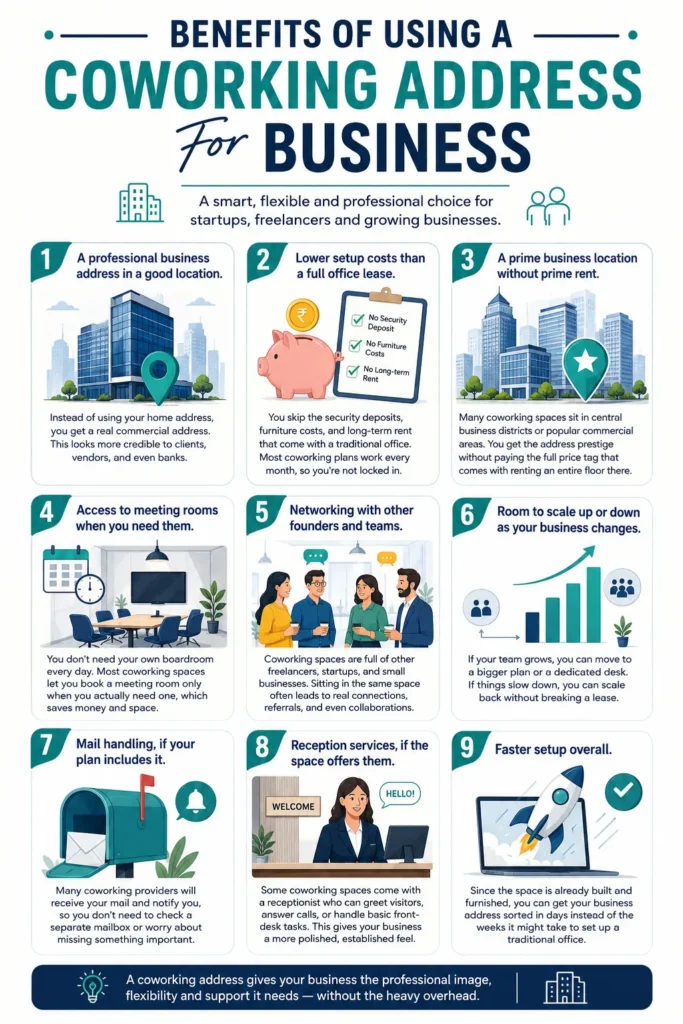
1. A professional business address in a good location. Instead of using your home address, you get a real commercial address. This looks more credible to clients, vendors, and even banks.
2. Lower setup costs than a full office lease. You skip the security deposits, furniture costs, and long-term rent that come with a traditional office. Most coworking plans work every month, so you’re not locked in.
3. A prime business location without prime rent. Many coworking spaces sit in central business districts or popular commercial areas. You get the address prestige without paying the full price tag that comes with renting an entire floor there.
4. Access to meeting rooms when you need them. You don’t need your own boardroom every day. Most coworking spaces let you book a meeting room only when you actually need one, which saves money and space.
5. Networking with other founders and teams. Coworking spaces are full of other freelancers, startups, and small businesses. Sitting in the same space often leads to real connections, referrals, and even collaborations.
6. Room to scale up or down as your business changes. If your team grows, you can move to a bigger plan or a dedicated desk. If things slow down, you can scale back without breaking a lease.
7. Mail handling, if your plan includes it. Many coworking providers will receive your mail and notify you, so you don’t need to check a separate mailbox or worry about missing something important.
8. Reception services, if the space offers them. Some coworking spaces come with a receptionist who can greet visitors, answer calls, or handle basic front-desk tasks. This gives your business a more polished, established feel.
9. Faster setup overall. Since the space is already built and furnished, you can get your business address sorted in days instead of the weeks it might take to set up a traditional office.
For a lot of small businesses, this mix of savings, flexibility, and professional presence is the main reason they choose coworking over a traditional lease.
Also Read: Coworking vs Traditional Office Space
Things to Check Before Choosing a Coworking Space
Don’t just take a salesperson’s word for it. Before you sign anything, ask:
- Does the provider allow company registration?
- Which documents will they give you?
- Is GST registration supported, where that applies?
- Is mail handling included in your plan?
- Can you upgrade to a bigger plan later?
- Are meeting rooms part of the deal?
- Are there any hidden charges?
A good coworking provider will have clear answers to all of these.
That’s usually a sign they’ve helped other businesses register before and know what paperwork to expect.
If a provider seems unsure or vague about registration, that’s a red flag.
Move on and find one that’s done this before.
Conclusion
A coworking address can be a smart, low-cost way to register your business, especially in the early days.
It saves you from signing a long lease before you even know if your business idea will take off.
Just make sure the provider actually supports registration and can hand you the right paperwork.
Ask questions early, get answers in writing, and pick a space that fits your budget as well as your plans to grow.
Do that, and you’ll get a professional address plus the flexibility to focus on what actually matters, which is running your business.
Frequently Asked Questions
1. Can I register my company using a coworking address?
Yes. Most coworking spaces that offer this service will let you register your business there, as long as you have the right documents.
2. Can I receive official government letters there?
Usually yes, if the coworking space offers mail handling. Ask before you sign up, since not every plan includes it.
3. Can I change my registered office later?
Yes. You can update your registered office address later if your business grows and you need a bigger space.
4. Is GST registration possible with a coworking address?
In many cases, yes. Rules vary by country and region, so it’s worth checking local requirements first.
5. Do I need a dedicated desk?
Not always. Some providers let you register your business even with a flexible or hot desk plan, but this depends on the space.
6. Is a virtual office different from a coworking space?
Yes. A virtual office gives you just an address and some mail services. A coworking space gives you an actual desk or office to use, plus the address.